
by Jamie Gale on Mar 17, 2026, 7:00:00 AM
Every CISO and security engineer eventually has to face: they no longer own their network.
In the era of the decentralized office, the traditional perimeter hasn't just been breached; it has evaporated. It vanished the moment an employee signed up for an AI tool using their corporate email. It vanished when a department stood up a SaaS suite on a personal credit card. It vanishes every time an employee decides that convenience is more important than your security policy.
Shadow IT is a reality. Gartner estimates that by 2027, 75% of your employees are likely using tools you didn't approve, didn't vet, and simply cannot see.¹
The Risk of the Unknown
We often treat Shadow IT as an administrative nuisance or a "SaaS sprawl" problem for the finance team. But for security, Shadow IT is a massive, unmanaged attack surface. When you don’t have user behavior analytics, you aren’t just flying blind; you’re responsible for a network that is being rewired by your users in real-time. This forensic gap is where breaches live. It’s the hours spent wondering if a DNS alert was a false positive or a user pasting proprietary source code into a public LLM. Without context, your Mean Time to Resolution (MTTR) isn't measured in minutes; it’s measured in days of guesswork.
Turning the Lights On
We didn't build CyberSight to add another dashboard to your rotation. We built it because you cannot defend what you cannot see.
By integrating deeply with the Windows Roaming Client, CyberSight captures the granular narrative of user behavior that DNS alone misses. It turns "unidentified traffic" into a clear, chronological story.
DNS Logs vs. CyberSight: The Evidence Gap
| Feature | Standard DNS Logs | CyberSight Intelligence |
| Destination | Domain level (e.g., ai.com) | Full URL path (e.g., ai.com/v1/chat/upload) |
| User Intent | Unknown | Contextual (Logs, locks, and active vs. idle state) |
| SaaS Instance | Sees "The App" | Distinguishes Corporate vs. Personal accounts |
|
Attribution |
IP / Device + User Name | Specific User Profile + Device State |
| Forensic Trail | Often limited by storage | 365-day searchable history |
Real-World Context: The "Idle-Time" Scenario
To understand the power of this visibility, consider a common investigation: A device starts a high-speed upload to a cloud storage site at 2:00 AM.
To a standard network filter, that looks like a legitimate sync or a background backup. But CyberSight provides critical device state layer. When you review the event timeline, you can see that this upload occurred while the device was locked and the user was idle. This context transforms a line of traffic into a clear indicator of compromise, giving you the forensic evidence needed to identify exfiltration that would otherwise blend into the noise.
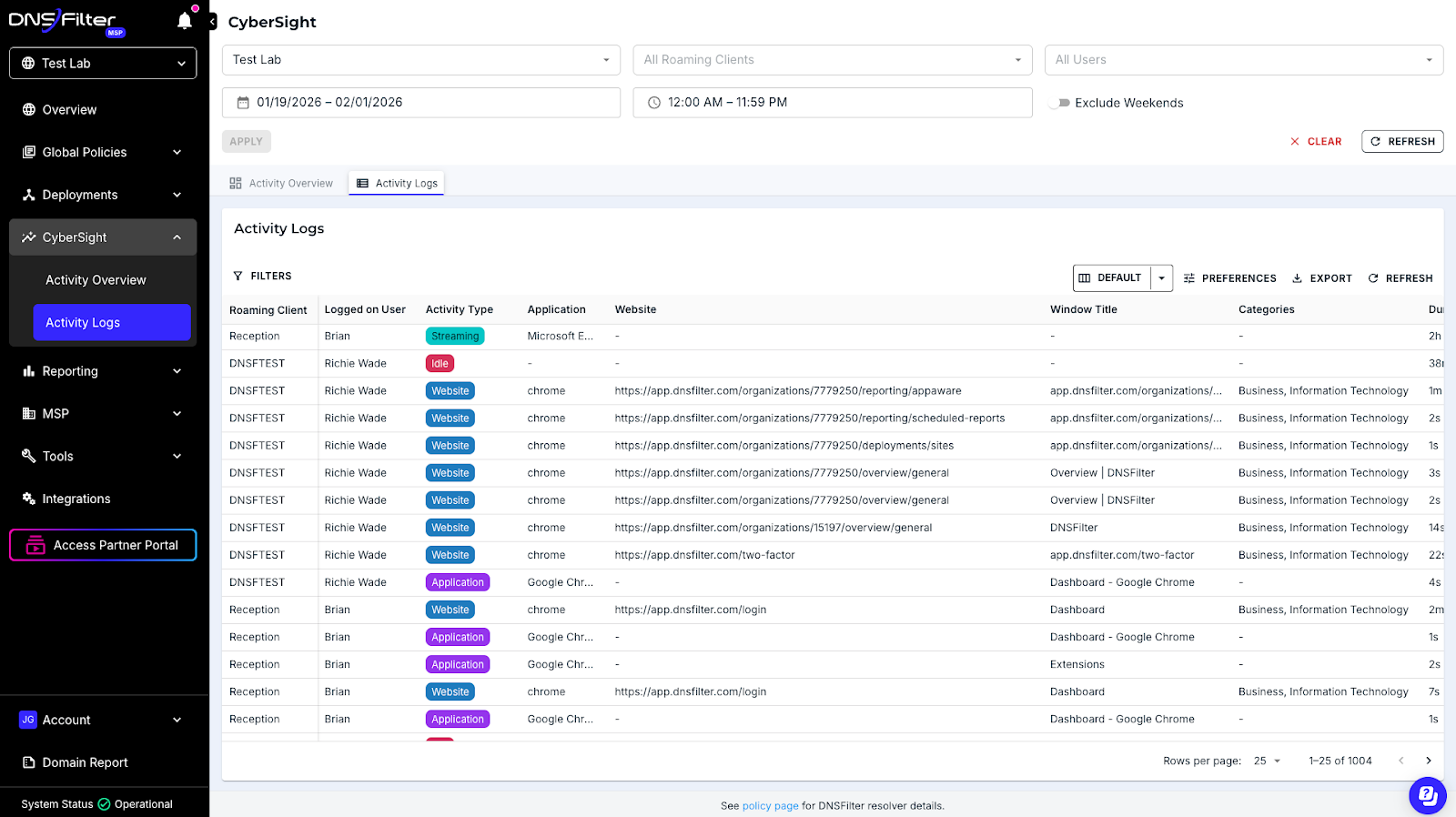
CyberSight activity logs showing detailed user activity.
Regaining the Lead
The traditional security model of "block by default" is hitting a breaking point. You cannot simply block your way to a secure culture when thousands of SaaS applications are only a click away. Visibility isn’t just an alternative to control, it is the prerequisite for it. We recognized that the most immediate threat to our customers wasn't a lack of tools, but a data void. Security teams need an active forensic trail to bridge the gap between a flagged event and a verified threat. CyberSight provides that context now, allowing you to move beyond guesswork and understand the specific user behaviors that put your organization at risk.
Information is the New Perimeter
CyberSight is available now for Pro and Enterprise users. Included is a data retention period of one year, so you will be able to conduct investigations with deep forensics and behavioral context. It’s a commitment to a simple idea: In a decentralized world, visibility is the only true form of control.
Ready to stop guessing and start seeing? Schedule a demo today.
 SecureTransit for MSPs: Digital Privacy Without Another Tool to Manage
MSPs need to boost client security without sacrificing efficiency or margin. Every extra tool, console, or license just adds overhead and slows down service delivery.
Privacy is a classic example. Clients want their remote and hybrid users protected from the networks they connect through and the trackers profiling them, but most solutions add another siloed tool and more operational work.

 How Black Hat Proved DNSFilter is on the Right Expansion Path
By Ken Carnesi, CEO & Co-Founder, DNSFilter
I've been going to Black Hat for years, and I can tell you plainly: This year was different.
Shadow AI and AI governance are top of mind now, an evolution from what we were hearing at RSA earlier this year. In an AI era, taking a DNS First approach to cybersecurity isn't optional, and we're built to solve exactly that problem.


